Feedback and testimonials:
At Trail Blazers, since 1887 our mission has always been to make the camp experience accessible to as many families as possible, regardless of income. For over 15 years, we’ve offered a tiered pricing model based on family income designed to support all the families in our community by removing financial barriers.
WHY TIERED PRICING?
Access and Equity. A tiered pricing model (often called a sliding scale) allows everyone to pay a similar percentage of their income for programs or services, ensuring wider accessibility to a more diverse group of families including those who might otherwise not be able to afford our programs. When families pay according to their resources, we create a more equitable community.
Commitment to Transparency and Trust. Trail Blazers provides information about our pricing tiers and program fees on each program page on our website. We believe that this information should be easily available to support our families in their decision making. Likewise, Trail Blazers does not ask for income verification. We trust that families will be honest about their income and resources and in doing so uphold our commitment to supporting each other.
Additional resources on Sliding Scales/ Tiered Pricing
(click the links to read)
Britt Hawthorne Embracing Equity
Alexis J. Cunningfolk The Sliding Scale: A Tool for Economic Justice
Additional Scholarships
Trail Blazers pricing tiers build financial support into the Belonging and Together Tiers as they do not reflect the full cost of programs. Limited additional scholarships are available for Community Tier families (Household income $60,000 and below). Applications for additional scholarships can be found on our registration platform or by contacting info@trailblazers.org. Applications are reviewed on a first come, first served basis.
UPDATED TIERED PRICING FOR SUMMER 2026
We updated our tiered pricing model to a simplified three-tier model in response to how our community and the cost of living have evolved in recent years with the goal of ensuring that it continues to serve families equitably. The new three-tier model applies to program registrations for Summer 2026 and forward. Tiered pricing will not change for the current 2025/ 2026 school year After School programs. Our new tiered pricing model will start for After School registrations for the 2026/ 2027 school year.
As part of our research, we reviewed data from the United Way’s ALICE (Asset Limited, Income Constrained, Employed) household income standards for New York State and Kings County which provided detailed information about current cost of living by geographic area and household size. You can learn more about the United Way’s ALICE model at UnitedforAlice.Org. We also analyzed the income ranges of our camp families across all programs. In developing our new model, the Trail Blazers team did extensive testing of different tiers and scholarship levels to ensure that it would not negatively impact current families. The income ranges for the new tiers are based on a household of 2 adults and 2 school age children who live in Brooklyn, NY where Trail Blazers is based.
Together Tier (Annual Household Income of $140,001 and above): This tier reflects the full cost of our programs. If you choose a tier below the Together Tier, you are receiving financial assistance. This tier is for families who are financially secure, able to meet their basic needs as well as have access to expendable income and personal savings. Families who are able to pay the full price invest in the Trail Blazers community by allowing us to prioritize financial support for those with the greatest need.
Belonging Tier (Annual Household Income $60,001 to $140,000): This tier reflects a significant discount from the full price of Trail Blazer programs. The middle price is for those who are able to meet their basic needs but have less expendable income depending on the size of your household. Paying for programs in this tier may qualify as a sacrifice but it would not create hardship.
Community Tier (Annual Household Incomes $60,000 and below): This tier reflects the greatest amount of financial support in the tiered pricing model and is reserved for families with the greatest needs. The Community Tier price is for those who struggle to meet basic needs and for those who paying for a program would be a significant hardship or not possible.
Our goal is to expand access to programs, increase equity, and promote transparency for everyone in our Trail Blazers community. We believe that the new three-tier system will make it easier for families to understand and select the tier that reflects their household income and available resources, ensuring that camp remains a welcoming place for all. We’re proud to continue our commitment to affordability, inclusion, and community support—values that have always been at the heart of Trail Blazers.
DONATE, Support Trail Blazers Campers and Our Commitment to Equitable Access!
Please donate to the Trail Blazers Scholarship Fund which makes our tiered pricing model and additional scholarships possible. Trail Blazers must actively fundraise to fill the financial gaps our tiered pricing does not provide for and ensure that all families can access our programs. Your support directly impacts campers and families in providing transformative camp and school experiences that stay with them for life. Visit TrailBlazers.Org/Donate.
Celebrating holidays
Topics Covered
Since 1939, Trail Blazer Camps has had the privilege of operating its summer overnight program and other outdoor educational programs at a magical property in Montague Township, NJ, that we lovingly refer to as our “Mashipacong Estate.” Trail Blazers acknowledges that this property is part of the Lenapehoking (land of the Lenni Lenape Indians) that included present-day northeastern Delaware, New Jersey and eastern Pennsylvania along the Delaware River watershed, New York City, western Long Island, and the Lower Hudson Valley; and was taken away from them by European colonists in the 17th century. Trail Blazers pledges to remember that we owe a great debt of gratitude to the Lenape people, past, present, and to come, for allowing us the opportunity to enjoy the land that they lived on and preserved, and we commit to preserving it for future generations.
We believe that Trail Blazers is a safe space for people to show up authentically, connect with each other, and be in community where people are fully seen and valued.
Placeholder for larger statement.
Click the links to read the posts about these specific events.
An Important Message on Indigenous People’s Day
George Floyd and Our Commitment to Doing Better
Regarding the January 6 Capitol Attack
Language updates
We believe that our community needs to be at the center of this work and the Committee hosted listening sessions with the goal of hearing the perspectives of key stakeholders: parents, current staff, alumni, and board of trustees. We believe it is important that we did not move forward without first hearing our community’s personal and shared views regarding where Trail Blazers is, what Trail Blazers does well, and what Trail Blazers needs to do better. The input gathered from the listening sessions informed our work as we developed a core set of DEIB initiatives, goals, and priorities. As this is on-going, it is our intent that our stakeholders continue to be actively engaged in this process.
The takeaways from the listening sessions were highly encouraging. We heard that stakeholders feel TBC works to create a culture that promotes a sense of welcome, warmth, and community. This is particularly evident in our program design, which creates opportunities for young people to build cross-cultural relationships; fosters an environment that focuses on one of camp’s unique strengths of supporting everyone, regardless of background, in learning and growing; and that these experiences have long-lasting effects throughout life – an example of what can be accomplished in the larger world. We also saw consensus on the importance of DEIB as it pertains to the value of our community and to TBC’s future. The listening sessions also identified areas in need of improvement, which has guided the “integration” and “priorities” conversations, in the following sections.
Next, the DEIB Committee assessed aspects of TBC’s business and infrastructure – People, Partnerships, Communications, Fundraising, Operations, Financials, Programming, and Culture – with the goal of building a roadmap to reach cultural proficiency and exemplary status. We chose the Meyer DEI Spectrum Tool for assessing our current state.
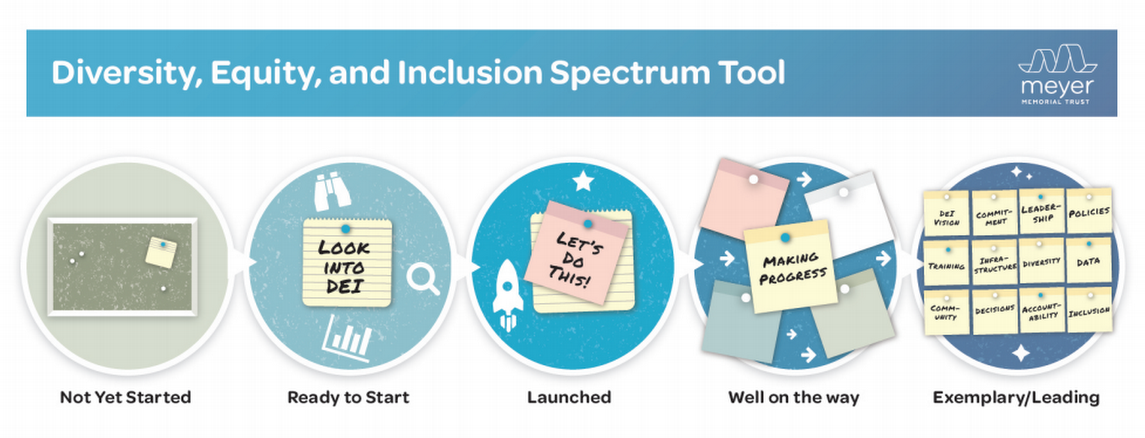
The tools functioned as our guide for assessing TBC’s progress on the path from “Not Yet Started” to “Launched” to “Well Underway” to “Exemplary” for each of the following 12 components: DEI Vision, Diversity, Commitment, Data, Leadership, Community, Policies, Decisions, Infrastructure, Accountability, Training, and Inclusion.
The findings, based on the committee’s assessment, are that Trail Blazers has a status of either Launched or Well Underway for a majority of the components assessed. The exceptions were Accountability, defined as the inclusion of DEIB-related metrics across all mechanisms, and Training, defined as fostering ongoing training, growth and leadership among management, staff and board.
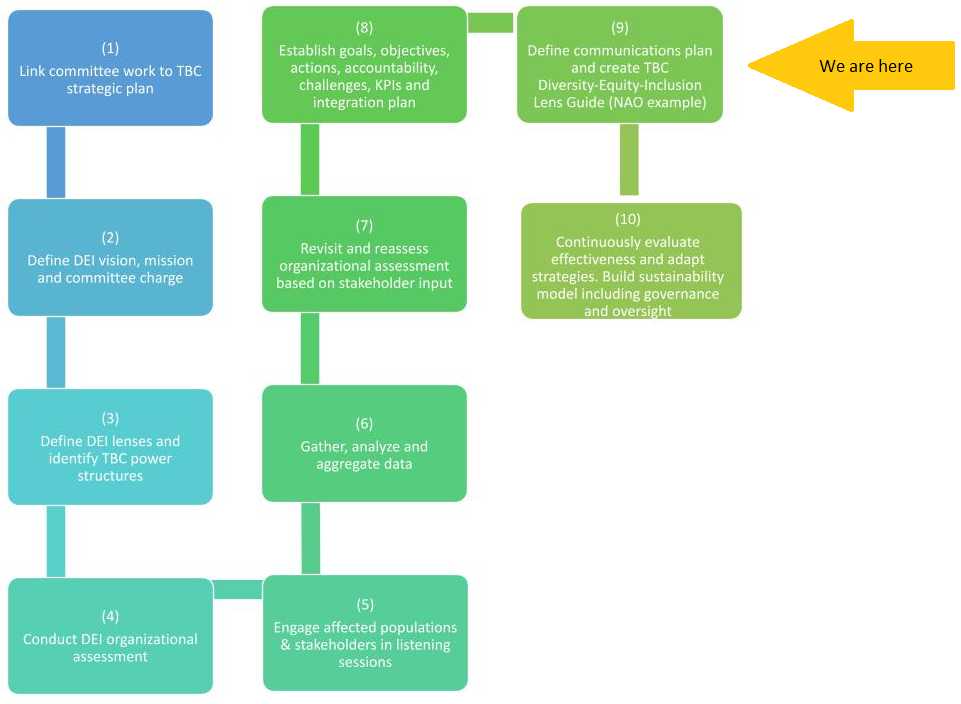
To institutionalize DEIB as a core and essential part of Trail Blazers, we integrated DEIB into our Mission and Vision statements, ensuring that it will guide how we govern, lead, communicate, operate, and interact. Furthermore, as our Primary Strategic Lens, DEIB will serve as our primary guide as we continue to operationalize our Strategic Plan and monitor its effectiveness through 2025.
We are currently at Step 9 on this path. The above tabs describe some of the work in each one of the steps and where we are going.

 English
 Arabic
 Chinese (Simplified)
 Dutch
Dutch French
 German
 Italian
 Portuguese
 Russian
 Spanish